


- 06/11/2026
- Laitex
Bottom ash is a coarse component of ash. Instead of going with the flue gases, it settles to the bottom of the boiler. Bottom ash handling refers to the process of removing and processing ash, slag, sand, and non-combustible particles from the bottom of a boiler to containers or a bunker. Applications can be utilized in different types of boilers. To avoid common confusion among slag, bottom ash, and fly ash, the comparison table below analyzes in detail the key differences between these three types of ash.
| Criteria | Fly ash | Slag ash | Bottom ash |
| Definition | Fine ash particles carried upward by flue gas in the combustion chamber and collected by filtration systems. | The entire solid waste mixture after combustion (including fly ash + bottom ash + slag). | Coarse, heavy ash and slag that naturally fall and accumulate at the bottom of the combustion chamber. |
| Physical characteristics & Size | Very fine powder, spherical particles, lightweight, high specific surface area. | Heterogeneous mixture comprising fine particles, coarse grains, aggregated slag, and clinker lumps. | Coarse-grained, porous/crumbly, or large slag lumps (clinker), sharp edges, high density, extremely heavy. |
| Abrasiveness | Moderate abrasiveness; however, the inlet temperature to the dust collector is only around 120–180°C, so no special heat-resistance requirements are needed for equipment. | Varying levels of abrasiveness depending on individual constituents. | Severe abrasiveness due to high Silica (SiO2) content; extremely high discharge temperatures (400°C to over 900°C). |
| Application | Premium additive for cement production, roller-compacted concrete, and precast concrete elements. | Depends on the separation and processing of individual components. | Used as road sub-base fill material, raw material for unburnt brick manufacturing, or crushed stone aggregate. |

Fly ash

Slag ash

Bottom ash
Bottom Ash Recycling Solutions
Bottom ash is primarily generated from the combustion of solid fuels (such as coal, biomass, municipal waste, etc.) in boiler furnaces, industrial kilns, and thermal power plants.
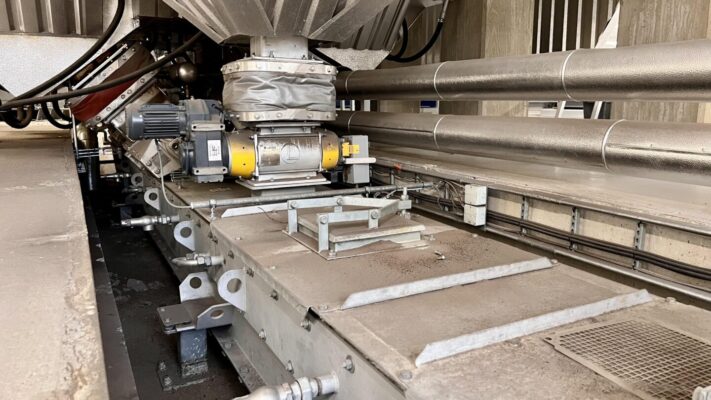
After fuel combustion, some of the ash remains at the bottom of the boiler. The collection, cooling, recycling, and storage of bottom ash is an important part of the boiler’s operation. After bottom ash is collected on conveyors, it’s cooled with cooling screws or chain conveyors. Cooled ash mixture is conveyed to screening where sand and ash are separated. Sand is recycled back to the boiler while ash and oversized particles are directed to containers or bunkers.
In certain boiler types, bottom ash is removed from the boiler by a wet ash conveyor. With this ash removal method, non-combustible material is extinguished, and the wet ash is transferred to the bunker.
Conveying systems for bottom ash
Bottom ash handling and sand recycling systems are part of Laitex’s full scope solutions. We have delivered a variety of systems around the world, regardless of size, boiler type and fuel.
Hot ash requires robust equipment that is designed for extreme conditions. Laitex’s hardwearing cooling screws and chain conveyors cool ash down rapidly by several hundreds of degrees. Cooling equipment is always tailored according to customers’ needs, and the cooling capacity is calculated using our own technology.

Cooling Screws are used for either rapidly cooling or heating the conveyed material. The conveying screw and frame act as heat exchangers using a liquid (water or water-glycol solution) for heat transfer. The material is cooled via a coolant flow inside the conveying screw and in the frame of the conveyor.
Chain Conveyors are used when bulk material is conveyed in an inclined angle. They are appropriate for conveying various materials that can be powdery, dusty and granular bulk materials.

Usually, coarse material is separated from the fine material with Drum Screen or Vibrating Screen. In this process, the sand is also separated from the ash and can be recycled back to the boiler. For long and complex distances, pneumatic transportation is a cost-effective option.
Ash is conveyed to storage using conveyors or pneumatic conveyor systems. Especially when silos are located far from the boiler building, pneumatic conveyors are an excellent choice.
Full scope solutions for bottom ash handling
In full scope solutions, the customer scope definition, engineering, automation, electrification, manufacturing, installation, commissioning including site related support, personnel training and after sales services are taken care of. Full scope delivery ensures that the system works seamlessly.
Flow goes on with Laitex expertise of various materials and process knowledge.


