


- 25/09/2026
- TANA Oy
Tối ưu vận hành bãi chôn lấp với giải pháp thông minh: Máy đầm nén rác thải
I. Current Context of Waste Landfills
In some localities, waste landfills were put into operation years ago under technical requirements and environmental standards are less developed than today’s. Consequently, certain facilities face technical infrastructure limitations, such as inadequate bottom liner systems, leachate collection and treatment, or landfill gas recovery.
Given the growing volume of waste, investing in infrastructure upgrades, applying suitable treatment technologies, and optimizing daily operations are recognized as key solutions to enhance waste management efficiency and extend landfill lifespan.
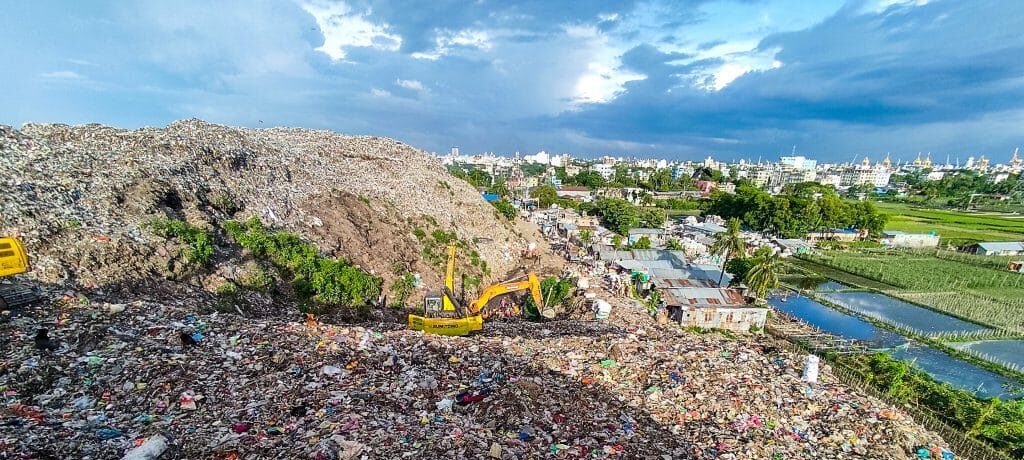
Image: Earth.Org
II. Challenges Facing Modern Landfills
Today’s waste landfills face a wide range of operational challenges, from handling ever-increasing volumes of waste to meeting stricter environmental requirements while controlling operating costs. Limited landfill capacity, odor emissions, leachate generation, the risk of underground fires, and declining landfill lifespan have become critical concerns that require effective solutions. In this context, the adoption of specialized equipment and technologies, such as landfill compactors, plays a vital role in improving operational efficiency and optimizing waste management practices.
Landfill operators are currently under pressure to address several key challenges, including:
- Continuously increasing volumes of incoming waste.
- Insufficient compaction density, which significantly reduces landfill lifespan and available airspace.
- Odor and dust emissions that affect the surrounding environment and nearby communities.
- The risk of smoldering fires within the waste mass, posing safety and environmental hazards.
- Growing leachate generation, increasing the burden on collection and treatment systems.
- Settlement and stability issues within the waste body over time.
- Rising operating costs, including fuel consumption and equipment maintenance expenses.
III. Solutions for Enhancing Operational Efficiency
To address these challenges, landfills must adopt advanced technologies combined with modern management practices to optimize the entire operational lifecycle. Efficiently managing the waste stream—from reception and processing to compaction—not only increases capacity but also extends the operational lifespan of the landfill.
Among these solutions, the TANA waste compactor plays a crucial role in increasing compaction density, maximizing usable capacity, and reducing operating costs. As a result, operators can boost economic efficiency, prolong landfill longevity, and maximize long-term investment value.
Beyond its superior compaction performance, TANA comes equipped with engines compliant with modern emissions standards, helping reduce NOx emissions and fine particulate matter into the environment. Its simple design, high reliability, and reasonable maintenance costs further optimize operational efficiency while meeting increasingly stringent environmental requirements in the waste management sector.
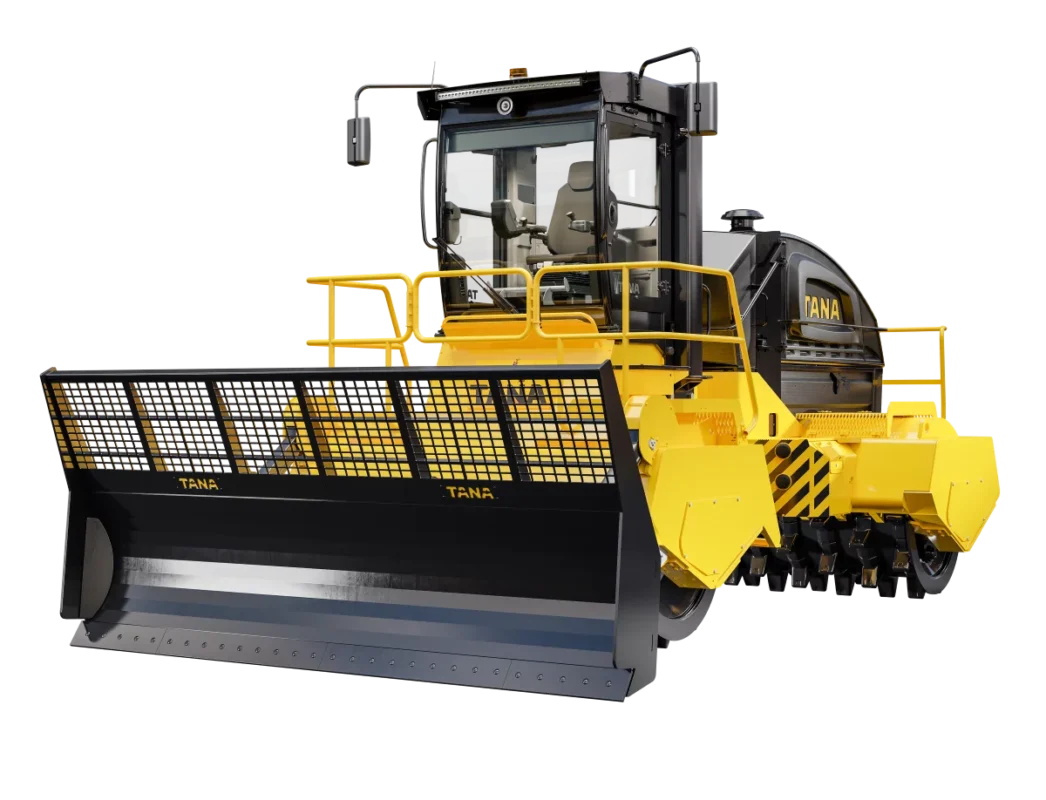
Caption: TANA Landfill Compactor
TANA waste compactor solutions designed specifically for Landfills:
One of the major challenges facing landfills today is the shortage of available land while the volume of incoming waste continues to increase. Many types of bulky or irregularly shaped waste create voids within the waste mass, reducing the effective use of landfill airspace and shortening the operational lifespan of the facility.
To address these challenges, TANA landfill compactors are specifically engineered to maximize waste compaction density. Featuring a rigid frame construction, twin full-width drums, and specialized crushing teeth, the machine distributes compaction force evenly across the entire waste surface, minimizing air pockets and improving landfill space utilization.
By achieving higher compaction densities, landfill operators can significantly increase the usable capacity of existing landfill cells without expanding the landfill footprint. This not only extends landfill lifespan but also helps reduce future investments in new disposal areas.
In addition, the compacted waste surface becomes more uniform and stable, supporting safer and more efficient landfill operations. Improved surface conditions help reduce the risk of settlement, facilitate daily cover activities, and contribute to more effective environmental management throughout the landfill site.


Rigid Non-oscillating Frame
- Structure: TANA compactors feature a rigid, one-piece frame construction that does not utilize an oscillating joint, unlike conventional wheel compactors or four-wheel landfill compactors.
- Benefits:
Directs 100% of the machine’s weight onto elevated areas of the waste surface.
Enables faster crushing and compaction of waste materials.
Creates a smoother and more uniform landfill surface, reducing the risk of waste mass instability and settlement.
Full-width Twin Drums
- Structure: TANA utilizes two large cylindrical drums extending across the full width of the machine, with one drum at the front and another at the rear.
- Benefits:
Provides full-width compaction with every pass, eliminating un-compacted gaps between wheels.
Reduces the number of passes required to achieve target compaction density.
Improves operational efficiency while lowering fuel consumption and operating costs.
Crushing Teeth
- Structure: Hundreds of heavy-duty steel teeth (typically 160 to 220 teeth depending on the model) are arranged in a diamond pattern across the drum surface. The drums are also equipped with scraper bars and wire cutters.
- Benefits:
Tear, puncture, and crush bulky waste materials such as foam containers, plastics, and construction debris, releasing trapped air and reducing waste volume.
Enhance compaction density by breaking down large waste items more effectively.
Scraper bars prevent waste from adhering to the drums, ensuring consistently high compaction performance.
Advanced Emission Control System
- Structure: The machine is powered by a high-performance engine equipped with electronic fuel management technology, an Exhaust Gas Recirculation (EGR) system, a Diesel Particulate Filter (DPF), and a Selective Catalytic Reduction (SCR) system.
- Benefits:
Optimizes combustion efficiency and reduces fuel consumption by up to 8-12%.
Minimizes harmful emissions and particulate matter (PM).
Complies with stringent environmental regulations and sustainability requirements for landfill operations.
Every TANA machine comes integrated with TanaConnect®—a smart fleet management platform that enables businesses to monitor machine status, operating performance, and operational data in real time. The system collects, analyzes, and visualizes data to support operational optimization, enhance productivity, and improve management efficiency. Through the TanaConnect® API, this data can also connect with maintenance, production, and ERP management systems, contributing to a synchronized, data-driven governance workflow.
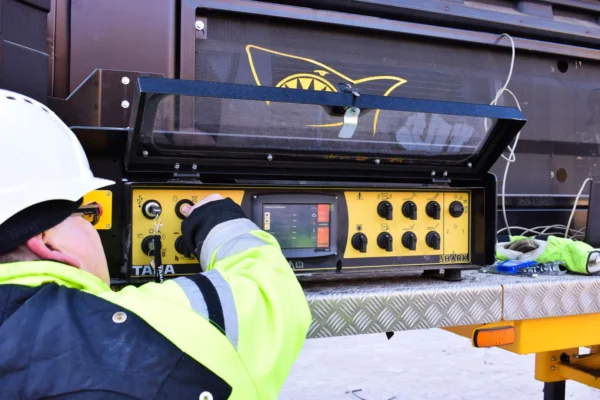
In addition, TANA equipment is equipped with the TANA Control System (TCS), featuring 12 pre-set operating modes that automatically adjust parameters such as rotor speed and pressure limits to ensure efficient shredding. When encountering uncrushable material that jams the rotor, the TCS automatically reverses the rotor or stops the machine, allowing operators to safely address and clear the blockage through the machine’s side door.
The TCS is also integrated with the engine’s electronic control system, enabling continuous monitoring of critical parameters such as:
- Pressure
- Temperatures
- Fuel consumption
- Operating hours
Through the combination of appropriate technologies and well-structured operational practices, landfill operators can increase waste intake capacity, reduce environmental management costs, and maximize profitability throughout the landfill’s service life.
At the same time, compaction performance is influenced by various factors, including the type of waste being handled and the equipment used. By optimizing operational processes with TANA solutions, landfill operators can achieve higher compaction efficiency, maximize landfill capacity utilization, and improve overall economic performance.
The video below highlights the design features and operating principles of TANA landfill compactors, demonstrating their ability to maximize landfill capacity and improve waste compaction density.
Source: YouTube TANA Oy


